Lineage
Location
Pictures
Books/Videos

|
Home
Page Lineage Location Pictures Books/Videos |
|
In the last issue we discussed how to do the archery stance like Yang Cheng-fu. But since reproduction of hand drawings is easier than photographs, which become unclear because of the poor quality of the pirated prints, most people take the short cut and use Fu Chung-wen’s drawings instead. But Fu has intentionally modified Yang’s foot angles and has supplied the transitional movement not based on Yang’s photographs.
One illustration will make the case clear. In the accompanying photograph of Yang, his rear foot angle is about 90 degrees. But in the drawing in Fu’s 1963 book based on the same photograph, the rear foot angle is changed to about 45 degrees. Probably, Fu, who learned from Yang in his early years, did not notice Yang’s later changes, even though Yang preferred his latest style. For authentic Yang Cheng-fu photographs, readers should consult Yang’s own photographs in "Application of Taichichuan," co-authored by Yang Cheng-fu and Tung Ying-chieh, Chung Hua Book Co., Shanghai, 1931, or the pirated copies in Taiwan and Hong Kong.
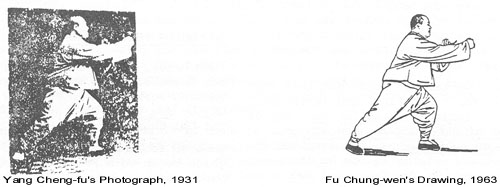
We defined Yang’s latest forward archery stance as being one foot directly pointing to your front with the rear foot forming about an 80-degree angle with the front foot. At the same time, the spine from the tailbone through the vertebrae to the shoulders and head squarely face the front in the direction of the front foot.
An obvious variation is Yang’s "Single Whip." In this posture, Yang’s left foot is pointing directly west, but his right foot is pointing directly south, forming an angle of about 90 degrees with the left foot. His left foot is bent like a bow and the right foot is stretched almost straight like an arrow. But in this posture he did not stretch his both hands to his front, or west. Instead, his right arm is stretched to the far right, with the fingers pointing to his right toes.
This posture is also considered to have the effect of expanding the chest. Because of the spreading of the two arms into a straight line (Single Whip), his chest is almost facing his direct south, but only very slightly toward the west (i.e. the direction of his left foot). Although his feet angles and the approximate bending of his legs are very similar to a forward archery stance, it is not a forward archery stance at all.
There are recent authors who have mixed up the principle of this posture with that of a real forward archery stance so that they turn their hips to face the front toes. This is a deviation from Yang’s form by mixing the two principles.
Another variation is Yang’s posture called "Fan." In this posture, his feet angles and knee bending are about the same. But his right elbow is away at his right side, so that he also cannot turn his hips and trunk to face the front toes.
The two photos below illustrate Yang Cheng-fu’s postures in the Single Whip and the Fan.
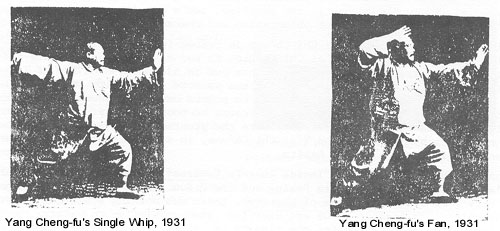
In both Single Whip and Fan, his trunk, from his tailbone to his shoulders, still form a straight line. The photographs show that instead of facing his left toes, his trunk faces to his side. His tailbone is not twisted, although he has turned his head to look to his left.
There are some recent authors who claim that the head should not be turned sidewise, and must always face the same direction as the trunk or shoulders. This will result in rigidity. Anyhow, before you strike, especially if you use a weapon such as a sword or a falchion, you have to turn your head to look at your target before you swing the weapon so that you will not hurt the wrong person.
Thus, we must clearly distinguish a real forward archery stance from a foot stance which is similar to an archery stance but is not a real forward archery stance. The forward archery stance is most used in Yang style Taichichuan.
Some examples of the forward archery stance include: Forward Warding, Squeezing*, Pressing*, Brush Knee and Press Palm Forward, Wild Horse Parts Its Mane, Fair Lady Moves Like Shuttle, Step Forward and Hammer Belly, Hit the Tiger, Twin Peaks Smashes at the Ears.
*Note on terms. The Chinese term for the forward archery stance in which you squeeze your left palm on your right wrist is called Ji, literally, squeeze. In the next forward archery stance, when both arms stretch forward, with both palms facing your front, the Chinese term is An.
Some English books translate this sub-posture into Push. But
in Tai Chi Chuan, any strength application is restrained. You
do not push forward like pushing a car. In ironing your clothing,
you use a restrained strength to press the iron on the cloth.
You do not push the iron into the cloth. The sub-posture An
should therefore be translated into "Press." The Chinese
word corresponding to push is Tui. In pushing a car, Tui
is used, not An.