Lineage
Location
Pictures
Books/Videos

|
Home
Page Lineage Location Pictures Books/Videos |
|
When the five Taijiquan books covering the Chen, Yang, Wu, Hao and Sun styles were published in the 1960’s and 1970’s, hand-drawn pictures traced from the masters’s photographs were used instead of photolithography. All drawings for the five books were by the same draftsman, and were expertly done.
But Yang Chengfu’s photographs, originally published in 1931, did not cover all the postures. for those available, only the final form of each posture is included. There is no transitional photograph from one posture to another. The author of the book on the Yang style, Fu Zhongwen, asked the draftsman to use free hand to draw the transitional pictures without basing them on Yang’s photographs.
Fu Zhongwen learned Yang’s early forms in childhood before Yang’s major improvement in his own 1931 book. Free hand drawings are therefore based on the way Fu learned in the early years.
As elaborately explained in my three articles in T’AI CHI, in April, June and August, 1993, Yang radically changed his foot alignment some time in the latter part of the 1920’s. Accordingly, the drawings in Fu’s book on Yang Style Taijiquan, 1963, did not show a consistent foot alignment.
For the convenience of discussion, the diagrams in my article in T’AI CHI, August, 1993, which compared three types of foot alignment are reproduced here.
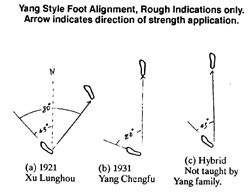 Diagram (a) is the foot alignment
learned by Fu Zhongwen. The front foot is not at the direct front,
but partly at the side, toes pointing diagonally, two feet almost
parallel. Although the rear foot forms a 45-degree angle with
the forward front line, it forms an 80-degree angle with the diagonal
line connecting the rear foot with the front foot; and this diagonal
line, indicated with an arrow, is the direction toward which the
strength from the rear heel is applied.
Diagram (a) is the foot alignment
learned by Fu Zhongwen. The front foot is not at the direct front,
but partly at the side, toes pointing diagonally, two feet almost
parallel. Although the rear foot forms a 45-degree angle with
the forward front line, it forms an 80-degree angle with the diagonal
line connecting the rear foot with the front foot; and this diagonal
line, indicated with an arrow, is the direction toward which the
strength from the rear heel is applied.
The foot alignment in Yang’s 1931 book is like diagram (b). The front foot is placed at the direct front toward which the forward strength from the rear heel is applied, as indicated by the arrow. The rear foot is 80 degrees sidewise with the forward front line. Therefore, in both Diagram (a) and Diagram (b), the rear foot is 80 degrees with the "line of strength application." Although Yang’s 1931 photographs changed the external appearance of his foot alignment, the method of his strength application remains similar. That is, in both cases the strength from the rear heel is directed toward the front foot, which forms an 80-degree angle with the rear foot.
Although the front foot in Yang’s own 1931 photographs is at his direct front, like Diagram (b), with the rear foot 80 degrees sidewise, Fu appeared to have ignored the difference from what he learned in childhood. Despite the change in Yang’s front foot placement, Fu continued to use his own system of making the rear foot 45 degrees with the forward line, or with the direction of his front foot. This is the hybrid system as shown in Diagram (c). The result is that part of the drawings for Yang in Fu’s book follows the foot alignment of Diagram (b) and the others follow the foot alignment of diagram (c).
The significance is that in Diagram (b), the rear foot forms an 80-degree angle with the direction of strength, whereas in Diagram (c), the rear foot forms a 45-degree angle with the direction of strength.
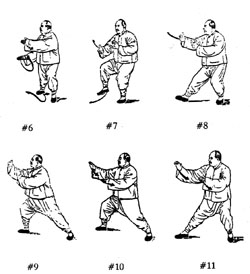 It may appear to some readers that
such discrepancy is of no important significance. But let us just
examine six of the drawings copied from Fu’s book, with the
original numbering of the pictures. Nos. 6, 9, and 11 are traced
from Yang’s photographs and Nos. 7, 8, and 10 are free hand
drawings.
It may appear to some readers that
such discrepancy is of no important significance. But let us just
examine six of the drawings copied from Fu’s book, with the
original numbering of the pictures. Nos. 6, 9, and 11 are traced
from Yang’s photographs and Nos. 7, 8, and 10 are free hand
drawings.Starting from #6, when Yang’s both feet are on the ground, the left rear foot is about 80 degrees sidewise, he turns in his rear foot to reduce the foot angle to 45 degrees sidewise before he raises his right front foot in #7. Then, in putting down right foot at his front in #8, he enlarges the rear foot angle to about 60 degrees sidewise. When he advances the trunk and bends his front knee in #9, he further enlarges his rear foot angle to 80 degrees. In starting to withdraw his trunk in #10, he narrows down his rear foot angle to 70 degrees. When his trunk is over his rear foot in #11, he turns out his rear foot to a 80-degree angle again. He almost changes his rear foot angle with each movement without following any principle.
The frequent turning of the rear toes during movements as shown in the pictures in Fu’s book destroys one’s stability. It does not allow the application of the integrated supple strength and the continuity of the internal energy, or qi. With some of the best ingredients of Taijiquan removed, the residual is the worst of martial arts and physical exercise.
To distinguish Yang’s true forms and alignment from the free hand drawings, one should go back to the original photographs of Yang. These are in the book, Application of Taijiquan, by Yang Chengfu and Tung Ying-chieh, Chunghua Book Co., Shanghai, 1931. Using Yang’s photographs, Tung wrote the complete texts, just as Chen Weiming who used Yang’s photographs to write his book, Methods of Taijiquan, 1925.
It must be pointed out that the unauthorized 1971 reprint of this book in Taiwan, because of some personal politics, omitted Tung’s name on the book cover and the title page. But the preface of the 1971 reprint, which was prepared by a neutral reprint committee, stated that the co-authorship of Yang and Tung was printed in the original 1931 edition of this book. Subsequent pirated versions, reprinted from the Taipei reprint, omitted the preface of the Taiwan reprint committee without restoring Tung’s name as a co-author.
This short note is written as a public service to help readers
who want to make use of the series of the hand-drawn pictures
of Yang Chengfu for any purpose. It also explains the consistency
and integrity of the art of Taijiquan in the hands of the great
master Yang Chengfu.